
August 4 1812: Jefferson's March on Canada

August 3 1812: Hull's Plan to Capture Tecumseh

On August 3 1812, Robert Lucas recalls that General Hull had come up with a plan to capture Tecumseh. It was a simple plan. Robert Lucas and Captain Knaggs would disguise themselves and go to Fort Malden and try to overpower Tecumseh. Lucas' sensibly notes "I was willing to do anything I was ordered but not to act foolishly, had we made the attempt agreeable to his plan we would been both taken, instead of taking Tecumseh, perhaps that was his wish." The excerpt from Robert Lucas`Journal is reproduced below describing the day in more detail.
August 3 1812: Southey to Wynn

On August 3, 1812, Robert Southey writes to his good friend, Charles Watkin Williams Wynn:
My dear Wynn:
I come to you once more for a frank, & leave the letter open that as you have seen Adderley’s paper you may see my reply to it, – a reply which will be as little satisfactory to you as to him. You will carry your point, – but if there must be another civil war, as I believe there will, if I were Prince Regent it should be upon this point, & not upon the next which must follow.
Revolutions in the moral world, like plagues in the physical one, will pursue their course. England I believe must have its turn, – the end may be good, but the operation xx of the medicine <must be> long & painful. The best hope I have is that we may be completely victorious abroad before the evil day comes on, & so have a clear field to ourselves as we had in the days of Charles I.
I will get Burkes works when I can meet with them at a sale price. In general I should most probably agree with him, – but not often in the application of his general views, – for never was there any man who so completely
To party gave up what was meant for mankind [1].
God bless you
RS
I am in hopes of seeing the Czar Peter here shortly. I wish you could drive down during your batchelor state to meet him. You have never seen me with my books about me. There is an easy way of coming by a mail from Liverpool, reaching Kendal in time for a six-o-clock coach to Keswick on Tuesday, Thursday & Saturday mornings. Secure a place at Liverpool, & you are here in 24 hours from Acton.
1. Quote from Oliver Goldsmith (1730–1774; DNB), ‘Retaliation; a Poem’ (1774), lines 28–31, ‘Here lies our good Edmund, whose genius was such,/We scarcely can praise it, or blame it too much;/Who, born for the universe, narrow’d his mind,/And to party gave up what was meant for mankind.
1. Quote from Oliver Goldsmith (1730–1774; DNB), ‘Retaliation; a Poem’ (1774), lines 28–31, ‘Here lies our good Edmund, whose genius was such,/We scarcely can praise it, or blame it too much;/Who, born for the universe, narrow’d his mind,/And to party gave up what was meant for mankind.
August 3 1812: The Tsar arrives
 On August 3, 1812, John Quincy Adams in St. Petersburg, Russia, learns that Emperor or Tsar has arrived:
3d. The Emperor arrived here this morning about two o'clock — I suppose because this is the Empress-mother's name-day, and one illumination answered for both events. I walked before breakfast in the Summer Gardens, and in turning round the boulevard I perceived the Imperial flag flying over the palace, which first gave me notice of the Emperor's return.
August 2 1812: Emulous Runs Aground

August 1 1812: Adams and Prejudice
On August 1, 1812, John Quincy Adams in St. Petersburg, Russia is in a philosophical mood reading Watt's Logic on prejudices. This probably refers to Isaac Watts Logic, or The Right Use of Reason in the Enquiry After Truth With a Variety of Rules to Guard Against Error in the Affairs of Religion and Human Life, as well as in the Sciences. It was first published in 1724. St Petersburg is expecting the arrival of Tsar Alexander. The inhabitants have been told by the police that the he may arrive any day and that they are expected to illuminate their homes on his arrival. The Tsar did not arrive today and Adams writes about prejudices and how to combat them:2d. I read some pages in Watts's Logic on the doctrine of prejudices, which occasioned the reflection how excessively difficult it is to divest one's self of prejudices, and how much more difficult still to discard prejudices without falling into indifference with regard to important truth. I believe the best guard against prejudice is a frequent examination of our opinions and a cool estimate of the arguments opposed to them. You must, as Cicero says, identify yourself, in imagination, first with your adversary and then with your judge, and, above all, you must have resolution to abide by the result, even if it should be adverse to your preconceived opinions. The victory over prejudice is a conquest of one's self. It is better than to be the ruler of a city.
August 1 1812: Harriet's Birthday
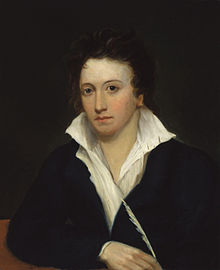 On August 1, 1812, Percy Bysshe Shelley, at Lynmouthon on the Devon coast with ever changing sea, celebrates the birthday of his wife, Harriet Westbrook, with a sonnet. She is turning 17. The poem is prematurely confident that their love will extend into their old age. Shelley imagines Harriet when her hair is grey writing that they will still love each other. Indeed, he writes "I must love thee more than this." Percy's poem reads:
O thou, whose radiant eyes and beamy smile
Yet even a sweeter somewhat indexing
Have known full many an hour of mine to guile
Which else would only bitter memories bring.
O ever thus, thus! as on this natal day,
Tho' age's frost may blight those tender eyes,
Destroy that kindling cheek's transparent dyes
And those luxuriant tresses change to grey,
Ever as now with Love an Virtue's glow
May thy unwithering soul not cease to burn.
Still may thine heart with those pure thoughts o'everflow
Which force from mine such quick and warm return,
And I must love thee ever more than this
Nor doubt that Thou and I part but to meet in bliss.
Subscribe to:
Posts (Atom)