Pages

December 28 1812: Elizabeth Craven


No news from the wandering Prince. Berkeley told me he was to come in March, which month I dread. I should think, by all accounts, that you are much gayer in Scotland than we are in England. Miss Welsley is married to a very rich young Mr Lytleton, and young John Madocks is to be married to a Miss Aclam, who is an immense fortune for him. This is all the news I know, except that Skeffington is a great friend of Betty's, and admires his acting, which I do not.

It is the fashion for every one to have violent coughs, and I am in that fashion. My brother the Admiral has bought a nice house in S. Audley Street, where he and his wife, Lady Emily, are coming to stay. I suppose the treatment he has received from Ministers will come out if Lord Wellington returns not well pleased, which, I suppose, must be the case if, as I suppose too, his frisk to Madrid was by orders from hence.

You must expect to have nothing but dull politics from me, for I hear nothing else; but I shall hope the spring will bring you and some other exotics to cheer us.

I only write now to say I am alive, and always wish to hear from you.—Believe me yours sin- Elizabeth, &c

— Elizabeth Craven (née Lady Elizabeth Berkeley), then  Baroness Craven, and then Margravine of Anspach,  writes to C. Kirkpatrick Sharpe on December 28th, 1812.

December 28 1812: Jefferson and Adams

On December 28 1812, Thomas Jefferson from Monticello, writes to John Adams.

Dear Sir,—An absence of five or six weeks, on a journey I take three or four times a year, must apologize for my late acknowledgment of your favor of October 12th. After getting through the mass of business which generally accumulates during my absence, my first attention has been bestowed on the subject of your letter. I turned to the passages you refer to in Hutchinson and Winthrop, and with the aid of their dates, I examined our historians to see if Wollaston’s migration to this State was noticed by them. It happens, unluckily, that Smith and Stith, who alone of them go into minute facts, bring their histories, the former only to 1623, and the latter to 1624. Wollaston’s arrival in Massachusetts was in 1625, and his removal to this State was "sometime" after. Beverly & Keith,who came lower down, are nearly superficial, giving nothing but those general facts which every one knew as well as themselves. If our public records of that date were not among those destroyed by the British on their invasion of this State, they may possibly have noticed Wollaston. What I possessed in this way have been given out to two gentlemen, the one engaged in writing our history, the other in collecting our ancient laws; so that none of these resources are at present accessible to me. Recollecting that Nathaniel Morton, in his New England memorial, gives with minuteness the early annals of the colony of New Plymouth, and occasionally interweaves the occurrences of that on Massachusetts Bay, I recurred to him, and under the year 1628, I find he notices both Wollaston and Thomas Morton, and gives with respect to both, some details which are not in Hutchinson or Winthrop. As you do not refer to him, and so possibly may not have his book, I will transcribe from it the entire passage, which will prove at least my desire to gratify your curiosity as far as the materials within my power will enable me.

December 27 1812: Jefferson on Perpetual Motion Machines


After an absence of five weeks at a distant possession of mine, to which I pay such visits three or four times a year, I find here your favor of November 30th.  I am very thankful to you for the description of Redhefer’s machine.  I had never before been able to form an idea of what his principle of deception was.  He is the first of the inventors of perpetual motion within my knowledge, who has had the cunning to put his visitors on a false pursuit, by amusing them with a sham machinery whose loose and vibratory motion might impose on them the belief that it is the real source of the motion they see.  To this device he is indebted for a more extensive delusion than I have before witnessed on this point.  We are full of it as far as this State, and I know not how much farther.  In Richmond they have done me the honor to quote me as having said that it was a possible thing.  A poor Frenchman who called on me the other day, with another invention of perpetual motion, assured me that Dr. Franklin, many years ago, expressed his opinion to him that it was not impossible.  Without entering into contest on this abuse of the Doctor’s name, I gave him the answer I had given to others before, that the Almighty himself could not construct a machine of perpetual motion while the laws exist which He has prescribed for the government of matter in our system ;  that the equilibrium established by Him between cause and effect must be suspended to effect that purpose.  But Redhefer seems to be reaping a rich harvest from the public deception.  The office of science is to instruct the ignorant.  Would it be unworthy of some one of its votaries who witness this deception, to give a popular demonstration of the insufficiency of the ostensible machinery, and of course of the necessary existence of some hidden mover?  And who could do it with more effect on the public mind than yourself ? I received, at the same time, the Abbe Rochon’s pamphlets and book on his application of the double refraction of the Iceland Spath to the measure of small angles.  I was intimate with him in France, and had received there, in many conversations, explanations of what is contained in these sheets.  I possess, too, one of his lunettes which he had given to Dr. Franklin, and which came to me through Mr. Hopkinson.  You are therefore probably acquainted with it.  The graduated bar on each side is 12 inches long.  The one extending to 37' of angle, the other to 3,438 diameter in distance of the object viewed.  On so large a scale of graduation, a nonias might distinctly enough subdivide the divisions of 10" to 10" each ;  which is certainly a great degree of precision.  But not possessing the common micrometer of two semi-lenses, I am not able to judge of their comparative merit. 

        —Thomas Jefferson, Monticello, writes to Dr. Robert Patterson, December 27, 1812

December 27 1812: Shelley and His Relations


I question if intimacy with my relations would add at all to our tranquility. They would be plotting and playing the Devil, or shewing us to people who would do so:— or they would bore & be dull, or they would take stupid likes or dislikes, & they certainly might cramp the liberty of our movements.

            — Percy Shelley,  in Tremadoc, Wales, December 27, 1812.

December 27 1812: Princess Charlotte and Caroline

On December 27 1812, Lord Byron writes to Lady Melbourne about Princess Charlotte, the estranged daughter of the Prince Regent,  and inevitably Lady Caroline Lamb. The latter has written to him with a "long account of the bonfire still more ludicrous than yours, full of Yeomanry, pages, gold chains, basket of flowers” – herself – & all other fooleries". 
My dear Ly. M. –  I know very little of the P’s party [Princess Caroline] & less of her publication (if it be hers) & am not at all in ye. secret, but I am aware that the advice given her by the most judicious of her “little Senate” has been to remain quiet & leave all to the P Ce. – I have heard nothing of the thing you mention except in ye. papers & did not imagine it to be hers. I by no means consider myself as an attache to her or any party, though I certainly should support her interest in Parliament if brought forward in any shape – & I doubt the possibility of the divorce – firstly – because he would already if he could – 2dly. – unless there is different law for Sovereign & subject she might recriminate (even were the charge proved) & by the law of the land as in Ld. Grosvenor & Duke C’s case there could be no divorce – 3dly. it would hurt the daughter 4 thly. if he married again & the Holy Ghost or any other begat him an heir – still there would be a party ready to bastardize the product of the 2 marriage by maintaining the legality of the first & denying his divorce to be legal – & 5thly . the uproar would be prodigious & injure his nerves – for my part I care not & think this country wants a little “civil buffeting” to bring some of us to our senses. – I shall not mention your name nor what you have said though I fully agree with you that it is much better for her to be quiet. – M’amie thinks I agree with her in{all} her politics, but she will discover that this is a mistake. – She insists always upon the P’s innocence but then as she sometimes reads me somewhat a tedious homily upon her own I look upon it in much the same point of view as I should on Mary Magdalen’s vindication of Mrs.  Joseph, or any other immaculate riddle. – I suspect from what you say & what I have heard that there will be a scene. – 

My proposed confidence to you will do for our [  ] meeting & consists merely of one or two slight {domestic} things on which I want to ask your advice, & you know I not only ask but take it when you please. – – I am glad C is so quiet – her account of my letter is right – her inference from it wrong – if she knew anything of human nature she would feel that as long as men love they forgive every thing, but the moment it is over they discover fifty things on which to ground a plausible & perpetual implacability. – She could not renew it – & this she knows, but she is quite right to reserve a point for Vanity. 
In her last she says “she shall quit the room or the house the moment I enter it.” I answered that she was to do as she pleased but that my carriage would be always respectful & as friendly as she thought proper to allow – an expression I now regret for she will interpret it into a wish to be again in her trammels which I neither would nor could. – Her letters were still more absurd than ever telling me she had “perjured herself to Lady Cr & Mrs. L” &c. to whom it seems I betrayed her &. (I can safely appeal to both as you will or may discover) & all this was my fault & so on. – 

Then comes a long account of the bonfire still more ludicrous than yours, full of Yeomanry, pages, gold chains, basket of flowers” – herself – & all other fooleries. – – Ld. O. goes to town on Saturday next, & we shall follow him the week or fortnight after – in the mean time write to me – we are very quiet & happy – but I shall certainly attend to what you say on travelling “en famille.” – Believe me dear Ly M ever yrs [Byron]

P.S. – I just hear that we shall not be in town before the 20th. – 


December 27 1812: Wordsworth Accepts the Annuity


"After mature consideration, I have resolved to trust to the first feelings excited by your letter; these were rather to owe any addition to my income required by me to your friendship than to the Government, or to any other quarter where it was not in my power to return what, in the common sentiments of men, would be deemed an equivalent. Asking permission therefore to retract my former determination, which I am encouraged to do by the personal intercourse, and marks of regard with which you have since distinguished me, and by the inscrutable delicacy of your last letter, I feel no scruple in saying that I shall with pride and pleasure accept annually the sum offered by your lordship until the office has become vacant, or some other change takes place in my circumstances, which might render it unnecessary. I cannot forbear to add that I feel more satisfaction from this decision, because my opinions would not lead me to decline accepting a pension from Government on the ground that literary men make some sacrifice of independence by such acceptance, and are consequently degraded. The constitution gives to the crown this power of rewarding acknowledged ability, and it is not possible to imagine a more worthy employment of a certain portion of the revenue. But it seems to me that the provisions made by our Government for the support of literature are far too scanty, and in this respect our practice is much inferior to that of other countries, where talents of importance to mankind and to posterity — but which from that very cause can bring little emolument to the possessor of them, and which demand all the thought of all his life — are undoubtedly (where they are understood) fostered and honoured, even as a point of pride. 

This is the case in Germany, and in France. . . . Now, as to the general question, it may be laid down as undeniable, that if to bestow be a duty (and an honourable duty), to accept cannot be otherwise than honourable, . . . "
 William Wordsworth, at Grasmere, writes to Lord Lonsdale on December  27, 1812. His children, including Willy, are recovering from the measles, but the grief of the death of Catherine and Thomas is still overwhelming. Needing to support his family, Wordsworth surrenders and accepts the annuity of £100 pounds a year from Lord Lonsdale.

December 26 1812: Joel Barlow Dies


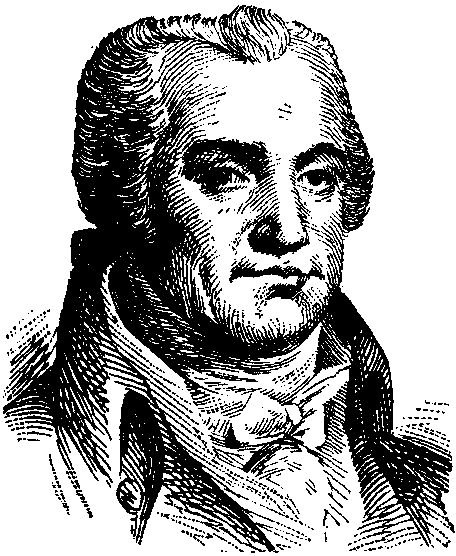
On December 26, 1812, or earlier on December 24 - the date is not certain [1] - the American diplomat to France, and poet Joel Barlow died of pneumonia in Zarnowiec, between Warsaw and Krakow. Barlow had pursued Napoleon to Vilna that year to try and negotiate a treaty between the United States and France. Napoleon was otherwise occupied at the time. Henry Adams will write of Barlow, perhaps a little unfairly, and the American relationship with France in 1812 as follows:
 
While Napoleon remained at Moscow, unable to advance and unwilling to retreat, Bassano wrote, October 11, from Wilna a letter to Barlow saying that the Emperor, regretting the delay which attended negotiation conducted at so great a distance, had put an end to the Due Dalberg's authority and requested Barlow to come in person to Wilna. The request itself was an outrage, for its motive could not be mistaken. For an entire year Barlow had seen the French government elude every demand he made, and he could not fail to understand that the journey to Wilna caused indefinite further delay, when a letter of ten lines to Dalberg might remove every obstacle; but however futile the invitation might be, refusal would have excused the French government's inaction. Throughout life Barlow exulted in activity; a famous traveller, no fatigue or exposure checked his restlessness, and although approaching his sixtieth year he feared no journey. He accepted Bassano's invitation, and October 25 wrote that he should set out the following day for Wilna. A week earlier, Napoleon quitted Moscow, and began his retreat to Poland.
Ten days brought Barlow to Berlin, and already Napoleon's army was in full flight and in danger of destruction, although the winter had hardly begun. November 11 Barlow reached Kbnigsberg and plunged into the wastes of Poland. Everywhere on the road he saw the devastation of war, and when he reached Wilna, November 18, he found only confusion. Every one knew that Napoleon was defeated, but no one yet knew the tragedy that had reduced his army of half a million men to a desperate remnant numbering some fifty thousand. While Barlow waited for Napoleon's arrival, Napoleon struggled through one obstacle after another until the fatal passage of the Beresina, November 27, which dissolved his army and caused him to abandon it. December 5, at midnight, he started for Paris, having sent a courier -in advance to warn the Due de Bassano, who lost no time in dismissing his guests from Wilna, where they were no longer safe. Barlow quitted Wilna for Paris the day before Napoleon left his army; but Napoleon soon passed him on the road. The weather was very cold, the thermometer thirteen degrees below zero of Fahrenheit; but Barlow travelled night and day, and after passing through Warsaw, reached a small village called Zarnovitch near Cracow. There he was obliged to stop. Fatigue and exposure caused an acute inflammation of the lungs, which ended his life Dec. 24, 1812. A week earlier Napoleon had reached Paris.
Barlow's death passed almost unnoticed, in the general catastrophe of which it was so small a part. Not until March, 1813, was it known in America; and the news had the less effect because circumstances were greatly changed. Madison's earnestness in demanding satisfaction from France expressed not so much his own feelings as fear of his domestic opponents. The triumph of Russia and England strengthened the domestic opposition beyond hope of harmony, and left the President in a desperate strait. No treaty, either with or without indemnities, could longer benefit greatly the Administration, while Napoleon's overthrow threatened to carry down Madison himself in the general ruin. In his own words, 
"Had the French emperor not been broken down, as he was to a degree at variance with all probability and which no human sagacity could anticipate, can it be doubted that Great Britain would have been constrained by her own situation and the demands of her allies to listen to our reasonable terms of reconciliation? The moment chosen for war would therefore have been well chosen, if chosen with a reference to the French expedition against Russia; and although not so chosen, the coincidence between the war and the expedition promised at the time to be as favorable as it was fortuitous."
Thus the year 1812 closed American relations with France in disappointment and mortification. Whatever hopes Madison might still cherish, he could not repeat the happy diplomacy of 1778 or of 1803. From France he could gain nothing. He had challenged a danger more serious than he ever imagined; for he stood alone in the world in the face of victorious England.
Notes
 1. The existing church tablet in Poland gives it as December 26.