 On August 7, 1812, is a contradictory day for General William Hull in Sandwich, Upper Canada. First, he gives orders to attack Fort Malden. Robert Lucas describes the exaltation of his men at last attacking the enemy. He writes: "the expected attack was on Malden every Countenance was cheered and their spirits raised with a prospect of having liberty to act in Defence of their Country." They would soon be disappointed as Hull countermanded the order and instead ordered that his army, at night, recross the Detroit River. Robert Lucas entry for August 7 1812 reads:
August 7 1812: Hull's Decision Day
On August 7, 1812, is a contradictory day for General William Hull in Sandwich, Upper Canada. First, he gives orders to attack Fort Malden. Robert Lucas describes the exaltation of his men at last attacking the enemy. He writes: "the expected attack was on Malden every Countenance was cheered and their spirits raised with a prospect of having liberty to act in Defence of their Country." They would soon be disappointed as Hull countermanded the order and instead ordered that his army, at night, recross the Detroit River. Robert Lucas entry for August 7 1812 reads: 
August 6 1812: Adams Learns of the WAR
On August 6 1812, John Quincy Adams, in St Petersburg Russia, learns that the United States has declared war on Great Britain on the June 18.

6th. Mr. Proud dined with us, and brought with him the New York Commercial Advertiser of 2 2d June, containing the message from the President of the United States to Congress, communicating the sequel of the correspondence between Mr. Monroe and Mr. Foster, and recommending a declaration of war; the report of the Committee of Foreign Relations upon this message, also recommending an immediate appeal to arms; the act declaring war, approved 18th June; the proclamation of the President founded upon the act of Congress; and the yeas and nays in both Houses upon the act — seventy-nine to forty-nine in the House of Representatives, and nineteen to thirteen in the Senate; two Senators, Mr. Bradley and Mr. Whitesides, absent. Minturn and Champlin sent off a pilotboat from New York to Gottenburg with this intelligence, for the purpose of securing their property there and here from British capture on this occasion. The vessel arrived at Gottenburg 23d July, and Mr. Proud, who is an agent of Minturn and Champlin, received the paper by express from that place.
August 5 1812: Adams in St Petersburg
On August 5, 1812, John Quincy Adams in St. Petersburg, Russia, makes the following entry in his diary:
5th. I met Don Francisco Colombi and Mr. Zea, who informed me that Count Wittgenstein had totally defeated Marshal Oudinot with great slaughter, and had taken his baggage, artillery, and three thousand prisoners. In Spain, too, he said, all was going on well, and Lord Wellington was at Salamanca.August 5 1812: Jefferson Letters

To General Thaddeus Kosciusko Monticello, August 5, 1812.Dear General,— I have little to add to my letter of June We have entered Upper Canada, and I think there can be no doubt of our soon having in our possession the whole of the St. Lawrence except Quebec. We have at this moment about two hundred privateers on the ocean, and numbers more going out daily. It is believed we shall fit out about a thousand in the whole. Their success has been already great, and I have no doubt they will cut up more of the commerce of England than all the navies of Europe could do, could those navies venture to sea at all. You will find that every sea on the globe where England has any commerce, and where any port can be found to sell prizes, will be filled with our privateers. God bless you and give you a long and happy life.


To James Madison Monticello, August 5, 1812.Dear Sir,— I am glad of the re-establishment of a Percival ministry. The opposition would have recruited our minority by half way offers. With Canada in hand we can go to treaty with an off-set for spoliation before the war. Our farmers are cheerful in the expectation of a good price for wheat in Autumn. Their pulse will be regulated by this, and not by the successes or disasters of the war. To keep open sufficient markets is the very first object towards maintaining the popularity of the war, which is as great at present as could be desired. We have just had a fine rain of 1¼ inches in the most critical time for our corn. The weather during the harvest was as advantageous as could be. I am sorry to find you remaining so long at Washington. The effect on your health may lose us a great deal of your time; a couple of months at Montpelier at this season would not lose us an hour. Affectionate salutations to Mrs. Madison and yourself.
August 5 1812: Tecumseh at Brownstown
Major Thomas Van Horne are heading to the River Raisin to pick up cattle and supplies and escort them for General Hull. The Americans were attacked by about 24 Natives led by the Shawnee war chief Tecumseh, Chickamauga war chief Daimee, Wyandot chief Roundhead, and several others. Tecumseh is greatly outnumbered by it is Van Horne who orders a retreat. Van Horne was able to save only half of his command; 18 men were killed, 12 were wounded, and 70 went missing. Robert Lucas below gives the American perspective.
August 4 1812: Brock and Martial Law
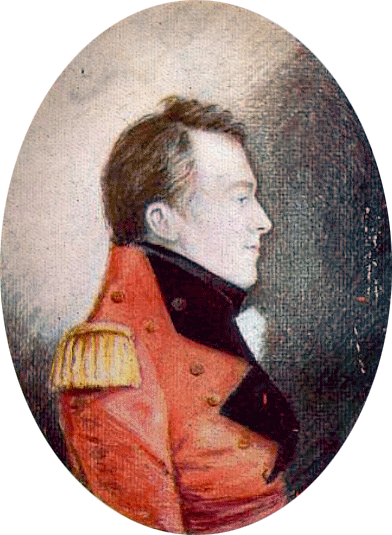 On August 4 1812, the Executive Council of Upper Canada, after a night's deliberation, informs Major General Isaac Brock, that it was their unanimous opinion that it was expedient to prorogue the legislature immediately and proclaim martial law. Earlier, Brock writes to Colonel Baynes and Sir George Prevost, both in Lower Canada. Brock is asking for more troops but it is clear that he intends to move to Fort Malden, or Amherstburg. His main concern is that Militia may not move with him as the Native tribes and nations residing in the Grand River have elected to remain neutral. The Militia will not move for fear that their families will be exposed to Native attacks. Frustrated, Brock contemplates removing the Native nations. He writes:"The moment Government be in a condition to do itself justice, the first step ought to be to expel the Indians from their present residence and place them out of the reach of doing mischief". His patience with the House of Assembly is also at an end. While writing to Prevost he learns that the House almost passed a bill that would have allowed the Militia to return home if they did not receive their pay on a fixed day in each month. Brock will prorogue parliament tomorrow on August 5 1812. The letter to Prevost is full of queries as to the extent of his power if he were to declare martial law. These letters are produced below.
August 4 1812: Hull Begins to think of Retreating
 On August 4, 1812, Brigadier General Hull in Sandwich, Upper Canada, writes to the Secretary of War. He is very concerned. "The unexpected surrender of Michilimackinac and the tardy operations of the army at Niagara are the circumstances to which I allude". Hull is already considering going back to Detroit. Tecumseh and his native warriors are threatening his supply lines. Hull writes: "Circumstances, however, may render it necessary to re-cross the river with the main body of the army, to preserve the communication for the purpose of obtaining supplies from Ohio". Hull's letter is reproduced below.
Subscribe to:
Posts (Atom)