Pages

July 6 1812: Beethoven's Immortal Beloved


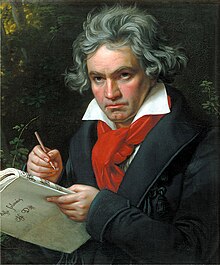
On July 6, 1812, Ludwig van Beethoven, is in Teplitz, where he has come for the medicinal waters on the advice of his doctor. In the morning, he begins to write three love letters to a woman that he will call his "Immortal beloved." The identity of the woman that inspired passionate expressions of love remains a mystery. The letters probably were never sent. They were found among Beethoven's  papers after his death. Scholars have speculated on the identity of the Immortal beloved but no one has been able definitively to identify her. 

Beethoven had a habit of falling in love with women who were unattainable or unavailable. These women ranged from Josephine von Brunsvik, a Hungarian aristocrat; to Countess Julia Guicciardi,  who had been his student when she was 16 years old; to Therese Malfatti, who he had thought of marrying; to Amalie Sebald, who received flirtatious letters from him; and finally to Antonie Brentano, a married, philanthropist, art collector, and arts patron. The mystery continues two hundred years later. The two letters written on July 6 1812 are reproduced below. There was a further letter written on July 7 1812.

July 5 1812: Jefferson to Greene

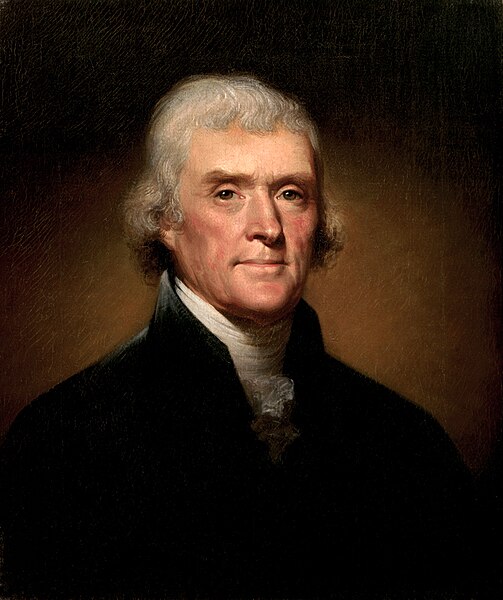
On July 5, 1812, Thomas Jefferson writes to Nathaniel Greene to acknowledge Greene's letter discussing, in part, his travels to Asia. The letter finds Jefferson in a cosmopolitan outlook. He notes that foreigners carry their own prejudices or, in his words, "peculiarities." He writes: "In reading the travels of a Frenchman through the United States what he remarks as peculiarities in us, prove to us the contrary peculiarities of the French. We have the accounts of Barbary from European and American travellers."

July 4 1812: Baynes to Brock

On July 4 1812, Colonel Baynes, on staff with Sir George Prevost, writes to Major-General Brock, in Upper Canada. Baynes advises that Prevost has called the legislature to declare martial law but primarily to set up a paper currency to pay the militia. Baynes writes "The proclamation for declaring martial law is prepared, and will be speedily issued. All aliens will be required to take the oath of allegiance, or immediately to quit the province. Our cash is at its last issue, and a substitute of paper must per force be resorted to." Baynes letter is reproduced below.

July 3 1812: Scott to Byron


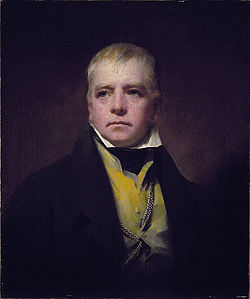
On July 3 1812, Walter Scott writes to Lord Byron as a result of the efforts of their joint publisher, John Murray, to reconcile them. In an earlier work, Byron had directed some satiric jibes at Scott. This is now being put behind them. Murray had conveyed to Scott a conversation that Byron had with the Prince Regent, where Scott was discussed in the most flattering terms. Scott now writes, in part, to praise Byron's Childe Harold even though his actual views are less flattering. On April 4 1812, Scott had this to say about Byron's poem:
Have you seen the Pilgrimage of Childe Harold, by Lord Byron? It is, I think, a very clever poem, but gives no good symptom of the writer's heart or morals. His hero, notwithstanding the affected antiquity of the style in some parts, is a modern man of fashion and fortune, worn out and satiated with the pursuits of dissipation, and although there is a caution against it in the preface, you cannot for your soul avoid concluding that the author, as he gives an account of his own travels, is also doing so in his own character. 
Now really this is too bad; vice ought to be a little more modest, and it must require impudence at least equal to the noble Lord's other powers, to claim sympathy gravely for the ennui arising from his being tired of his wassailers and his paramours. There is a monstrous deal of conceit in it too, for it is informing the inferior part of the world that their little old fashioned scruples of limitation are not worthy of his regard, while his fortune and possessions are such as have put all sorts of gratification too much in his power to afford him any pleasure. Yet with all this conceit and assurance, there is much poetical merit in the book and I wish you would read it. 
Scott's  letter  is reproduced below.  


July 3 1812: Brock to Prevost


On July 3, 1812, Major General Isaac Brock writes to Sir George Prevost, in Lower Canada. Brock writes that he is anxious to receive commands from Prevost as to what steps to take in the "present emergency". Brock has called out the militia of about 800. He also notes "They turned out very cheerfully, but already shew a spirit of impatience". He thinks that he can get about 4,000 men who will be paid in paper currency. Brock`s letter is reproduced below.

July 2 1812: Cuyahoga Packet Captured


On July 2, 1812, the schooner Cuyahoga Packet is sailing up the Detroit River when it is spotted on the Canadian side, at Amherstburg, by Lieutenant Frederic Rolette. Cuyahoga is sailing slowly past the British fort. The day before General William Hull's American Army of the Northwest had reached Lake Erie. Hull still did not know that war had been declared. He hired the  Cuyahoga to carry his personal baggage, band instruments and sick soldiers upriver. His  personal baggage includes his journals, war plans and all his correspondence with Secretary of War William Eustis. The rest of the army continued to cut their way through the Michigan forests on their way to Detroit.

When Rolette spots the Cuyahoga, he rows out with six armed men in a longboat. Captain Chapin of the Cuyahoga is surprised when Rolette demands that he surrender his vessel and men. After some hesitation and a warning shot from Rolette, the captain is convinced to surrender. In any event, he is not in a position to resist. All the arms of the Cuyahoga are stowed below deck. There are thirty soldiers on board but they are too sick to fight.  

After securing the vessel, Rolette informs Captain Chapin that the United States has declared war. Rolette  also "liberates" some musical instruments. As the Cuyahoga sets sail for Fort Malden, Rolette forces the Americans to play "God Save The King."

Later, Rolette discovers Hull's personal baggage with the cargo that had been captured.  These documents provide valuable intelligence that is forwarded to General Brock. 

July 1 1812: Napoleon Has A Meeting

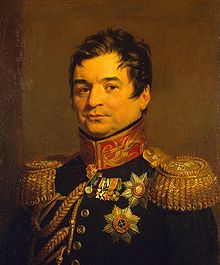
On July 1 1812, Napoleon summons General Alexander Dmitriyevich Balashov to a meeting. Balashov is carrying a letter from Alexander offering to negotiate but not while there remains one French soldier on Russian soil. The meeting takes place in the same room where Alexander had given Balashov the letter six days earlier[1]. Napoleon has taken the Tsar's headquarters as his own. Napoleon now reads the letter and explodes. He is by turns angry, petulant, abusive, and always menacing. Stamping his feet. Pacing the room. Shouting. Ripping a window from its hinges and throwing it [2]: 
"Alexander is making fun of me. Does he really think I have come all the way to Vilna to negotiate commercial treaties?" 

"They must be thrown back into the the icy wastes, so that they do not meddle in the affairs of civilized Europe for the next twenty-five years at least."

Or perhaps: "I have come to finish off, once and for all, the Colossus of Northern Barbarism. The sword is drawn. They must be thrust back into their snow and ice, so that for quarter a century at least they will not be able to interfere with civilized Europe. 

"We must cure the Russians of their curiosity about what goes on in Germany. I consent to admitting the English to Archangel, but the Baltic should be closed to them. Why did not Alexander explain himself to Narbonne or to Lauriston, who was at Petersburg and whom he would not receive at Vilna" 

"I am already in Vilna, and I still don't know what we are fighting over"

"Now that the Tsar sees it is a serious matter, and that His army has been cut in two, he is afraid. and wants to come to terms; but I will sign the peace at Moscow."
When Balashov left, Napoleon speaks of Alexander: "He has rushed into this war which will be his undoing, either because he has been badly advised, or because he is driven by his destiny. But I am not angry with him over this war. One more war will be one more triumph for me."

Notes
1.  Adam Zamoyski, Moscow 1812. Napoleon’s Fatal March, New York 2004, page 159
2. The above quotes of Napoleon are taken from Adam Zamoyski, Moscow 1812. Napoleon’s Fatal March, New York 2004, pages 159-160; and Armand de Caulaicourt, At Napoleon's Side in Russia, The Memoirs of General de Caulaincourt, Duke of Vicenza, (Enigma Books), pages 44 to 45